

Key result
+180% monthly organic sessions, generated 241 direct bookings & signals
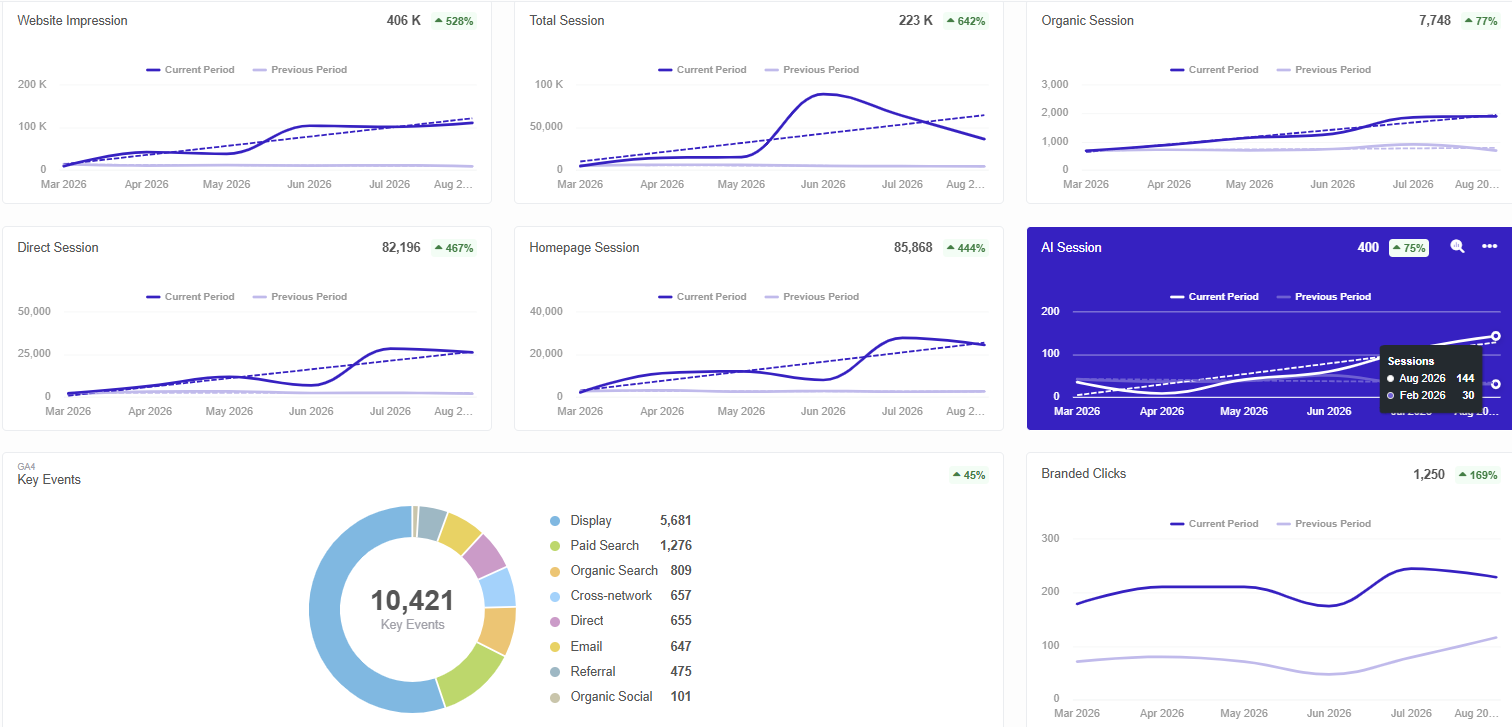
Monthly organic sessions grew from 678 in March to 1,899 in August 2026. In August, organic search recorded 241 booking-related and contact actions. The resort also recorded 157 sessions attributed to ChatGPT, Gemini, Copilot and Perplexity, with 13 tracked package, offer and dining actions from those sessions.
By Shaun Huy · Reporting period: March–August 2026 · Updated: 8 September 2026 · Engagement ongoing
Disclaimer: NDA signed; the resort’s name cannot be mentioned.
The results at a glance
| Performance highlight | Result | Period |
|---|---|---|
| Organic search traffic growth | +180% — 678 → 1,899 sessions | March vs August 2026 |
| Google search click growth | +203% — 387 → 1,171 clicks | March vs August 2026 |
| Year-on-year organic traffic growth | +186% | August 2026 vs August 2025 |
| AI-source website visits | 157 sessions, including 147 from ChatGPT | August 2026 |
| Organic booking-related and contact actions | 241 recorded actions | August 2026 |
| AI-attributed package, offer and dining actions | 13 recorded actions | August 2026 |
AI figures throughout this case study cover ChatGPT/OpenAI, Gemini, Copilot and Perplexity.
August organic sessions were also 186% higher than August 2025, when the same property recorded 664 sessions. That comparison helps put the growth in context beyond the change between March and August.
The figures describe website discovery and recorded actions. Confirmed room bookings and booking revenue are outside the evidence available for this case study.
The challenge: connect discovery to the resort’s actual offering
The resort wanted to grow organic traffic, win more first-page search visibility and bring more guests into its direct channels. Its brief called for technical, content and local SEO implementation, alongside support for AI search discovery.
The practical challenge was a multilingual website with several commercial entry points: accommodation, family facilities, dining and offers. Each needed useful content, a working technical foundation and a clear connection to the next action a visitor could take.
The resort’s identity also needed attention. Its brand name was inconsistent across channels, and it was being confused with other IHG-affiliated resorts in the Phuket area. The work needed to make clear which property each website, listing and set of contact details referred to.
There were also concrete implementation issues. The work log records missing translated content and issues with language, sitemap and metadata functions in the CMS. A future website replacement was part of the client’s brief, so the existing website still needed attention while that longer-term change remained ahead.
AI traffic was already present in March. The starting point was 33 AI-source sessions, which provided an early channel to monitor and develop.
The approach: build around what travellers need to decide
My GEO methodology starts with the connection between demand and what a business can actually provide. For a resort, family facilities, room options, dining and location information provide specific reasons a traveller might consider the property.
Generative Engine Optimisation, or GEO, is the work of improving how a business can be discovered and represented in AI-generated answers. In this engagement, the work connected that objective with the existing SEO programme: clarify the property’s identity, strengthen commercial pages, expand useful supporting content, improve the links between them and monitor what visitors did next.
The following workstreams show how the implementation maps to that methodology.
1. Clarify the resort’s identity across owned and third-party channels
Several resorts in the Phuket area sat under the wider IHG umbrella. Inconsistent use of this resort’s brand name made it easier for information about one property to be mixed up with another.
I mapped the resort’s exact name, address and phone number (NAP) and its relationship to IHG. I then mapped the connections between the property, its official website and its third-party profiles, using the same property identity as the reference point.
I implemented corrections across owned and third-party channels to make the brand name and contact details consistent. The purpose was to distinguish this resort from nearby sister properties and ensure that the information pointed to the right business.
This is entity connection in practical terms: make the relationship between a property, its brand affiliation and its online presence clear. It supports accurate representation for guests and search systems. The reporting below does not isolate the effect of this work from the rest of the programme.
2. Strengthen the pages that explain the resort
The content refresh covered the homepage, accommodation sections, family content and dining pages. Later work covered facilities, a family pool, children’s activities and offers.
These are what I call infrastructure content: the pages that explain what the business offers, who it suits and what someone can do there.
For this resort, the useful relationships were specific: a family traveller and the facilities available to them; a dining need and the relevant restaurant; an accommodation choice and the room information supporting it. Those relationships give the content a purpose beyond repeating a broad hotel keyword.
Missing content in translated accommodation pages was filled, and revised service pages were published in translation. This extended the information available across the website’s languages.
3. Expand useful content around the stay
The programme combined new articles with revisions to existing content. The work log records recurring briefs, drafts, publishing and translation, including Hindi, Korean and Thai.
The August search data shows discovery extending into local guides about activities, dining and places to visit. These pages gave travellers ways to find the resort’s website while researching their trip.
This maps to information coverage in my methodology: cover relevant questions around the stay and connect that information to the property’s offering.
The role of these guides was to support decisions. A visitor researching family activities needs a useful answer, followed by a relevant route to accommodation or facilities if they want to explore the resort further.
4. Connect guides, facilities and commercial pages
Internal-link improvements included grouping existing content and connecting pages around the children’s facilities, with further optimisation completed in August.
That connection matters to both the content structure and the visitor journey. A guide can introduce a need; a facility or accommodation page can explain how the resort meets it; an offer or contact action can provide the next step.
Within my methodology, this is how supporting content connects back to the commercial pages it is meant to help. The relationship should be visible in the links and page content, rather than left for the reader to work out.
5. Resolve technical issues alongside content delivery
Website audits ran alongside the content programme. In July, work on language, sitemap and metadata functionality in the CMS was completed.
This is the technical foundation of the approach. Publishing and translating content depends on the website handling that content properly.
6. Follow search and AI traffic through to actions
A GEO prompt set was prepared in April. Later tasks explicitly covered checking AI sessions, optimising content and improving calls to action on high-performing pages receiving organic and AI traffic.
Key-event tracking on blogs and service pages was also checked. This made the measurement question more useful: which pages attracted visits, and what recorded actions followed?
That reflects the measurement sequence in my GEO methodology: visibility → website engagement → business outcomes, with each connection examined separately.
How performance developed
Organic sessions and Google search clicks increased across each of the six reporting months.
| Month in 2026 | Organic sessions | Google search clicks |
|---|---|---|
| March | 678 | 387 |
| April | 888 | 476 |
| May | 1,139 | 525 |
| June | 1,279 | 928 |
| July | 1,864 | 971 |
| August | 1,899 | 1,171 |
March and August both contain 31 days. The headline comparison uses those complete months, rather than mixing a partial month with a full one.
What the August organic traffic produced
The resort’s 1,899 organic search sessions were associated with 241 recorded booking-related and contact actions in August:
| Recorded action | Organic search events |
|---|---|
| Package submission | 164 |
| Offer submission | 18 |
| Dining booking-button click | 42 |
| book_now_submit event | 12 |
| Contact-form submission | 5 |
| Total | 241 |
These actions show visitors interacting with packages, offers, dining and contact options after arriving through organic search. The total excludes “Book now” views and the additional contact conversion tag.
These are tracked website events. One visitor can take several actions; confirmed bookings are a separate measure.
What the August AI traffic produced
Of the 157 AI-source sessions in August, 147 were attributed to ChatGPT, eight to Gemini, one to Perplexity and one to Copilot.
Across those sessions, the selected event set recorded:
- 7 package-submit events
- 3 offer-submit events
- 3 dining booking-button clicks
That is 13 recorded actions, including 11 attributed to ChatGPT and two to Copilot. They are event counts, so one visitor or session can generate more than one action. They should not be read as 13 unique guests or 13 completed bookings.
What the results support
The evidence supports a clear finding: the resort’s website attracted substantially more organic search traffic across the reporting period, while AI sources became a larger source of visits and generated measurable actions.
It also shows where the next measurement gap sits. The data connects AI-attributed sessions to package, offer and dining interactions. Connecting those interactions to confirmed room bookings and revenue requires booking-system evidence.
An AI referral count also cannot establish what proportion of all relevant AI answers mentioned the resort. Although the project prepared a prompt set, a comparable historical mention-rate series was not available for this case study. This case study therefore uses traffic and action data.
The programme included several changes at once, alongside the resort’s wider marketing activity. This is an observed campaign outcome, not a controlled test proving that a naming correction, rewrite, internal link or technical fix caused the increase.
What I would carry into the next phase
The next priority is to connect the growing discovery data more closely to guest decisions: identify the guides and commercial pages bringing relevant visitors, keep improving the route to an action, and reconcile those actions with confirmed outcomes.
The work remains ongoing. August’s 1,899 organic sessions and 157 AI-source sessions provide the next baseline for that work.
For a hotel marketer assessing SEO and GEO, this case gives a practical example of the work involved: consistent property information, entity connections, commercial-page improvements, useful travel content, translation, internal links, technical fixes and measurement of the resulting visits and actions.
Explore my SEO and GEO approach, or get in touch to discuss your hotel’s search visibility and path to direct bookings.
Measurement note
Data was retrieved on 8 September 2026 from the property-specific Google Analytics 4 and Google Search Console connections in AgencyAnalytics, with implementation checked against Asana project records. Organic sessions use the Organic Search channel under the session-primary channel grouping.
The AI comparison set covers ChatGPT/OpenAI, Gemini, Copilot and Perplexity. AI sessions use their session source/medium labels, including recorded referral, unassigned-medium and AI-assistant variants. The 13 August actions use package-submit, offer-submit, contact-submit and dining-click events; no contact-submit events occurred in the selected AI rows.
Source labels are attribution data, not independent verification of an AI recommendation. Google Search Console clicks cover web search and are not presented as a non-branded-only or AI-only measure. Client-specific URLs and internal project links have been withheld.