

How hotels appear in ChatGPT search results — and how to win
Based on 332 ChatGPT API responses across 30 hotel search prompts for Danang, Vietnam · September 2026
- 332 API responses
- 30 unique prompts
- 14.8 avg local pack size
- 5.2 avg cited sources
I ran 15 broad prompts (“Best hotels in Danang”) and 15 detailed prompts (“Best luxury family resort in Danang with kids pool”) through ChatGPT’s live search, ~11 times each. This playbook distills what the data says about how hotels surface in AI search — and what you can do about it.
Part 1: Findings
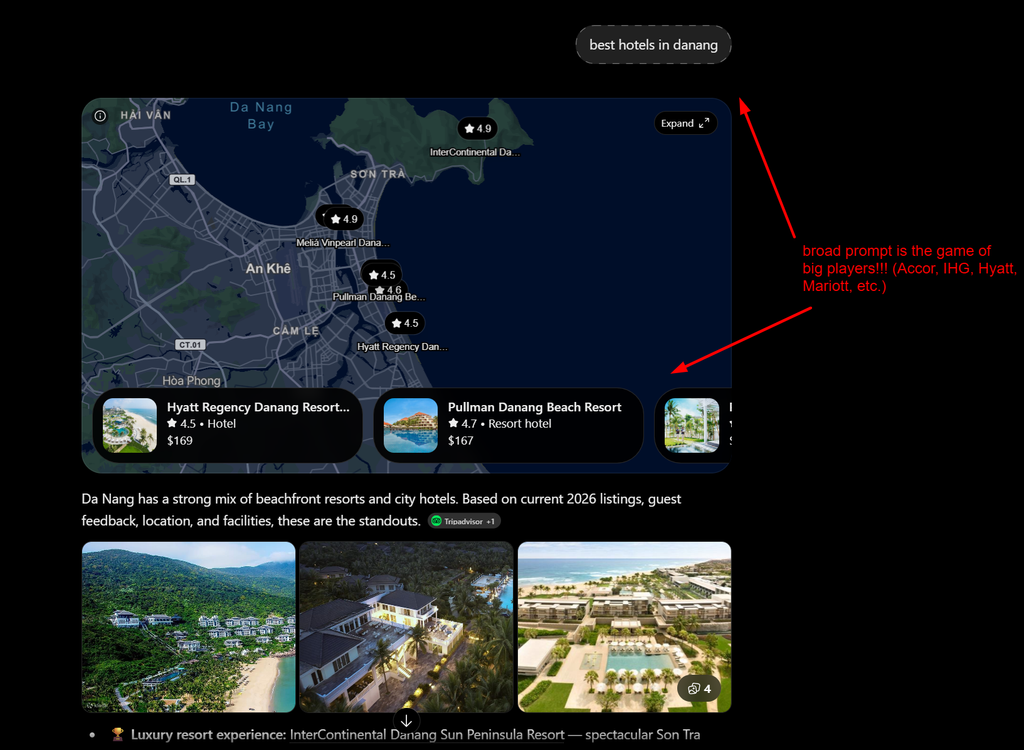
The AI search response anatomy
Every ChatGPT hotel search produces two distinct components: a local pack (a map-style list of ~15 hotels with names, ratings, review counts and links) and a text response (a curated editorial pick of 5–7 hotels with prose descriptions, inline citations and clickable brand-entity links). Occasionally, a comparison table appears for “where to stay” or “resort list” queries. Each component has different rules for what appears and why.
Finding 1: Broad and detailed queries surface fundamentally different hotel sets
Broad queries are an oligopoly: the same 6–7 chain hotels (InterContinental, Hyatt, Pullman, Sheraton, Four Seasons, Naman Retreat) appear in 80–95% of all broad responses regardless of wording. Detailed queries break this pattern — each intent surfaces a largely unique set of hotels tailored to the specific need.
Evidence: InterContinental Danang appeared 138 times across broad queries vs 81 across detailed. Budget queries (D3) had zero overlap with luxury queries (D9). Pet-friendly queries (D10) surfaced hotels that appeared in no other query type.
Finding 2: Detailed queries are the battleground for independents
Independent and boutique hotels almost never break into broad query results, but they dominate many detailed categories. Naman Retreat appeared in 88 detailed results vs 69 broad. Fusion Resort appeared in 53 detailed vs only 8 broad. This is where microsite content strategy pays off.
Evidence: Fusion Resort & Villas appeared 53 times in detailed queries but only 8 times in broad — a 6.6x ratio. Parosand Danang Hotel, a strong independent, appeared primarily through detailed “where to stay” and “budget” queries.
Finding 3: The citation source varies by query intent — predictably
The dominant citation source type flips depending on what the user asks. This isn’t random: brand.com wins when the query asks about a specific hotel feature that a property page documents. OTAs win when the query asks for list-style discovery. Travel blogs win for experiential or area-based queries.
Citation source breakdown by query intent
| Prompt | Intent | Dominant source | OTA | Brand | Micro | Blog |
|---|---|---|---|---|---|---|
| D6 | Kids club | Brand 67% | 0% | 67% | 21% | 12% |
| D15 | Accessible | Brand 66% | 31% | 66% | 0% | 3% |
| D9 | Private beach & pool | Brand 45% | 11% | 45% | 4% | 40% |
| D1 | Family & kids pool | Brand 36% | 16% | 36% | 23% | 25% |
| D3 | Budget | OTA 100% | 100% | 0% | 0% | 0% |
| D8 | Near airport | OTA 100% | 100% | 0% | 0% | 0% |
| D10 | Pet-friendly | OTA 82% | 82% | 0% | 0% | 18% |
| D4 | Honeymoon | OTA 69% | 69% | 0% | 0% | 31% |
| D11 | Business | OTA 45% | 45% | 12% | 32% | 10% |
| D14 | Solo female | Blog 96% | 4% | 0% | 0% | 96% |
| D7 | Villa for couples | Blog 89% | 5% | 4% | 2% | 89% |
| D12 | Eco & sustainable | Blog 82% | 0% | 7% | 11% | 82% |
| D2 | Couples & ocean view | Blog 59% | 37% | 4% | 0% | 59% |
| D13 | Anniversary | Blog 58% | 0% | 27% | 15% | 58% |
| D5 | Boutique & spa | Blog 48% | 42% | 0% | 10% | 48% |
Finding 4: Microsites with feature-specific pages get cited as authoritative sources
The single most powerful content strategy observed: danang.intercontinental.com had 90 citations across the study — 89% from detailed queries. It was cited because it has dedicated sub-pages for sustainability, kids programs (Planet Trekkers), romantic venues, room types and swimming pools. Each page answers a specific query intent directly.
Evidence: danang.intercontinental.com was cited for eco queries (sustainability page), family queries (Planet Trekkers + resort-info), couples queries (perfectly-romantic page), anniversary queries (room-suites page), and even had PDFs cited (Kid-Activities.pdf for D6).
Finding 5: Brand.com entity links ≠ brand.com citations. They serve different functions.
ihg.com was the #1 entity link domain (225 links — used as the clickable hotel name) but had only 21 source citations. Conversely, danang.intercontinental.com had 90 citations but 0 entity links. Entity links come from Google Business profiles; citations come from indexable content that answers the query.
Evidence: Entity link ranking: ihg.com (225), hyatt.com (224), marriott.com (174), all.accor.com (163). Citation ranking: TripAdvisor (388), Booking.com (200), vietmapper.com (191), danang.intercontinental.com (90).
Finding 6: Booking.com monopolises queries where hotel content is absent
When no hotel has dedicated content for a query intent, Booking.com fills the void entirely. Budget (D3) and near-airport (D8) queries sourced 100% from OTAs. Pet-friendly (D10) had 82% OTA citations — and in one run, Booking.com’s pet-friendly page received 7 citations in a single response.
Evidence: If no hotel in the market has a /pet-friendly or /airport-transfer page, Booking.com’s filtered list page becomes the sole authoritative source. This is the content gap hotels can fill.
Finding 7: TripAdvisor dominates broad queries; travel blogs dominate niche detailed queries
TripAdvisor received 388 total citations — 82% from broad queries. Its filtered list pages (“Romantic Hotels”, “Boutique Spa Hotels”, “5-Star Hotels”) serve as go-to sources for generic recommendations. But for experiential queries (solo female, eco, couples, villa), purpose-written travel blog posts dominate completely, receiving 96% of citations for solo female travel queries.
Finding 8: Hotels without their own website lose all brand control
Hotels without a branded domain get entity-linked through OTAs (Booking.com or Agoda), sending potential guests to a third-party listing page. Premier Village Danang appeared frequently in local packs but consistently had no URL at all in entity links — across all 332 runs.
Finding 9: Results are remarkably consistent across runs
Core hotels appeared in 9–10 out of ~11 runs for any given prompt. Citation source domains rotated slightly (different TripAdvisor sub-pages, different blog posts) but the domain-level pattern was stable. The 7th–15th positions in the local pack showed more variation — this is the competitive margin.
Finding 10: Google review count correlates with local pack prominence
Melia Vinpearl Danang Riverfront (17,218 Google reviews) appeared 91 times despite being a riverfront property — not a beach resort. High review counts appear to boost local pack prominence across diverse query types, including business and accessibility queries where the property’s core positioning differs from the query intent.
Top cited source domains
- TripAdvisor — 388 citations
- Booking.com — 200
- vietmapper.com — 191
- IC Danang microsite — 90
- marriott.com — 72
- daytripsvietnam.com — 62
- danangpointer.com — 62
- hyatt.com — 51
- pullman-danang.com — 49
- roavara.com — 45
Part 2: Optimisation Checklist
Ranked by impact based on the experiment data. High-priority items target the biggest citation gaps — the intents where OTAs currently win by default because no hotel content exists.
Website & technical foundation
[HIGH] Have a branded website with a dedicated property domain
Hotels without their own domain get entity-linked through Booking.com or Agoda, losing all brand control. Premier Village Danang had zero URL across all 332 runs. At minimum, register a domain and have a functional homepage with NAP data (name, address, phone), rooms overview, and a booking link.
[HIGH] Claim and optimise Google Business Profile
The local pack draws from Google Business data. Ensure your GBP listing has the correct website URL (your branded domain, not an OTA), complete category tags, updated photos and accurate contact details. This is where entity links originate.
[MEDIUM] Build a microsite or sub-domain for your property
Chain hotels: a property-level microsite (like danang.intercontinental.com) dramatically outperforms a brand.com listing page. The IC microsite received 90 citations vs ihg.com’s 21, because the microsite has 20+ specific feature pages that answer query intents directly. If you can’t do a full microsite, create deep sub-pages on your property’s brand.com listing.
Intent-specific content pages
[HIGH] Create a /family or /kids page with specific amenities
Family queries (D1, D6) are one of the few intents where brand.com beats OTAs (67% brand citations for kids club queries). Hyatt’s Kid-Activities.pdf and Camp Hyatt page were cited repeatedly. List your kids pool dimensions, kids club hours, child menus and family room configurations. Upload downloadable PDFs of activity schedules.
[HIGH] Create an /accessibility page with detailed specifications
Accessibility queries sourced 66% from brand.com — the highest brand share of any intent. voco Ma Belle’s ihg.com/accessibility page and Radisson’s rooms page with wheelchair specs were cited. List: roll-in showers, grab bars, doorway widths, elevator access, accessible pool entry, accessible restaurant seating. Specificity wins — “wheelchair accessible” alone is not enough.
[HIGH] Create a /pet-friendly page
Pet-friendly queries sourced 82% from Booking.com because no hotel had dedicated pet content. This is the clearest content gap in the data. If your hotel allows pets, create a page listing: weight limits, pet fees, pet-friendly rooms, nearby walking areas, pet amenity kits. One hotel filling this gap would likely replace Booking.com as the primary citation.
[HIGH] Create a /sustainability or /eco page
IC Danang’s sustainability and environmental-commitment pages were the only hotel sources cited for eco queries. Detail your waste reduction, energy certifications, local sourcing, plastic-free initiatives and any eco awards. This content does double duty: eco queries (D12) AND broad “best resorts” queries where sustainability differentiates.
[MEDIUM] Create a /rooms/pool-villa or /private-pool page
Villa and private-pool queries (D7, D9) cite marriott.com sub-property pages and travel blogs. If you have pool villas, create a dedicated page with villa types, pool dimensions, privacy features and pricing tiers. Marriott’s Non Nuoc Beach Villas pages were cited for this intent.
[MEDIUM] Create a /romantic or /couples page
IC Danang’s “perfectly-romantic” venue page was cited for honeymoon and couples queries. For anniversary queries (D13), room-suites pages showing specific room categories were key citations. Include: couples packages, in-room dining, spa-for-two options, sunset venues and any wedding/anniversary planning services.
[MEDIUM] Create a /business or /meetings page
Business queries cited Trip.com (a rare appearance — 3 citations in one run) and pullman-danang.com. Pullman’s microsite blog content about business facilities was cited. Include: meeting room specs and capacity, business centre hours, airport transfer details, co-working spaces and corporate rate information.
[LOW] Add an /airport-transfer page
Near-airport queries (D8) sourced 100% from Booking.com. Any hotel with airport shuttle or proximity advantage can capture this intent with a simple page: distance, transfer time, shuttle schedule, taxi cost estimates and pickup instructions.
Reviews & reputation
[HIGH] Actively build Google review volume
Review count correlates with local pack prominence. Melia Vinpearl Danang Riverfront (17,218 reviews, 4.9 rating) appeared in 91 responses including query types outside its core positioning. Hotels with fewer than 2,000 reviews rarely appeared consistently. Set up post-stay review request flows and respond to reviews to signal activity.
[MEDIUM] Maintain a 4.5+ Google rating
The average rating of hotels appearing in the local pack was 4.5–4.7. Hotels with ratings below 4.3 appeared far less frequently. Address negative reviews, train staff on guest experience touch points and monitor review sentiment trends.
Third-party & PR strategy
[HIGH] Get featured in travel blog “best of” and area guide posts
Travel blogs supplied 50.1% of all citations and dominated solo female (96%), villa/couples (89%), eco (82%) and anniversary (58%) query intents. The most-cited blogs were vietmapper.com (191), daytripsvietnam.com (62) and danangpointer.com (62). Pitch these specific publications. A mention in a “Where to Stay in Danang 2026” guide translates directly into AI search recommendations.
[MEDIUM] Ensure your TripAdvisor listing is in the right filtered categories
TripAdvisor’s filtered list pages (“Romantic Hotels”, “Boutique Spa Hotels”, “5-Star Hotels”, “Honeymoon Resorts”) were cited 388 times — the #1 source domain. Being included in these filtered lists means appearing in ChatGPT’s curated picks. Verify your property categories, update amenity tags and maintain a strong TripAdvisor ranking.
[MEDIUM] Optimise your Booking.com listing for niche filters
Booking.com’s filtered pages (accessible-traveling, pet-friendly, airport) are the default source when hotel content doesn’t exist. Even if you build your own pages, ensure your Booking.com listing has all amenity filters correctly tagged — the filtered pages that cite your property create a reinforcing signal.
Content strategy & maintenance
[HIGH] Pick 2–3 query intents and build deep content for them
Don’t try to win every query. The most successful independent properties owned a niche: TIA Wellness dominated wellness/spa across all runs. Naman Retreat owned eco + couples + luxury. Parosand dominated budget + “where to stay”. Identify your 2–3 strongest intents and create the deepest content in your market for those.
[MEDIUM] Upload downloadable PDFs for activity menus, kids programmes and wedding packages
Hyatt’s Kid-Activities.pdf was cited directly in family queries. IC Danang’s PDF documents were cited for anniversary and family queries. ChatGPT can index and cite PDF documents hosted on your website — these are high-specificity assets that OTAs cannot replicate.
[MEDIUM] Publish blog content on your microsite about local guides and experiences
pullman-danang.com’s blog posts were cited for business, family and anniversary queries. chiclandhotel.com was cited for eco queries via blog content. A microsite blog answering “things to do” and “how to plan” questions for your target traveller segments creates citable assets that generic property pages cannot.
[LOW] Date-stamp and update content annually
Multiple cited travel blog articles included “2026” in their titles (danangpointer.com/private-pool-guide-2026, visitdanang.travel/family-amenities-2026). ChatGPT appears to preference recently-dated content. Update your feature pages with current-year information, seasonal programmes and any new amenities or renovations.
Methodology: 332 responses from ChatGPT’s live search API (DataForSEO ChatGPT Scraper) across 30 hotel search prompts for Danang, Vietnam — 15 broad and 15 detailed, each run ~11 times between Sep 21–22, 2026. Location: Vietnam (country-level). Language: English. Data includes local pack listings, text response citations, brand entity links and comparison tables.